September 15, 2026
The Brain’s Energy Governor: Tuning the OMA1-DELE1-HRI Safety Switch
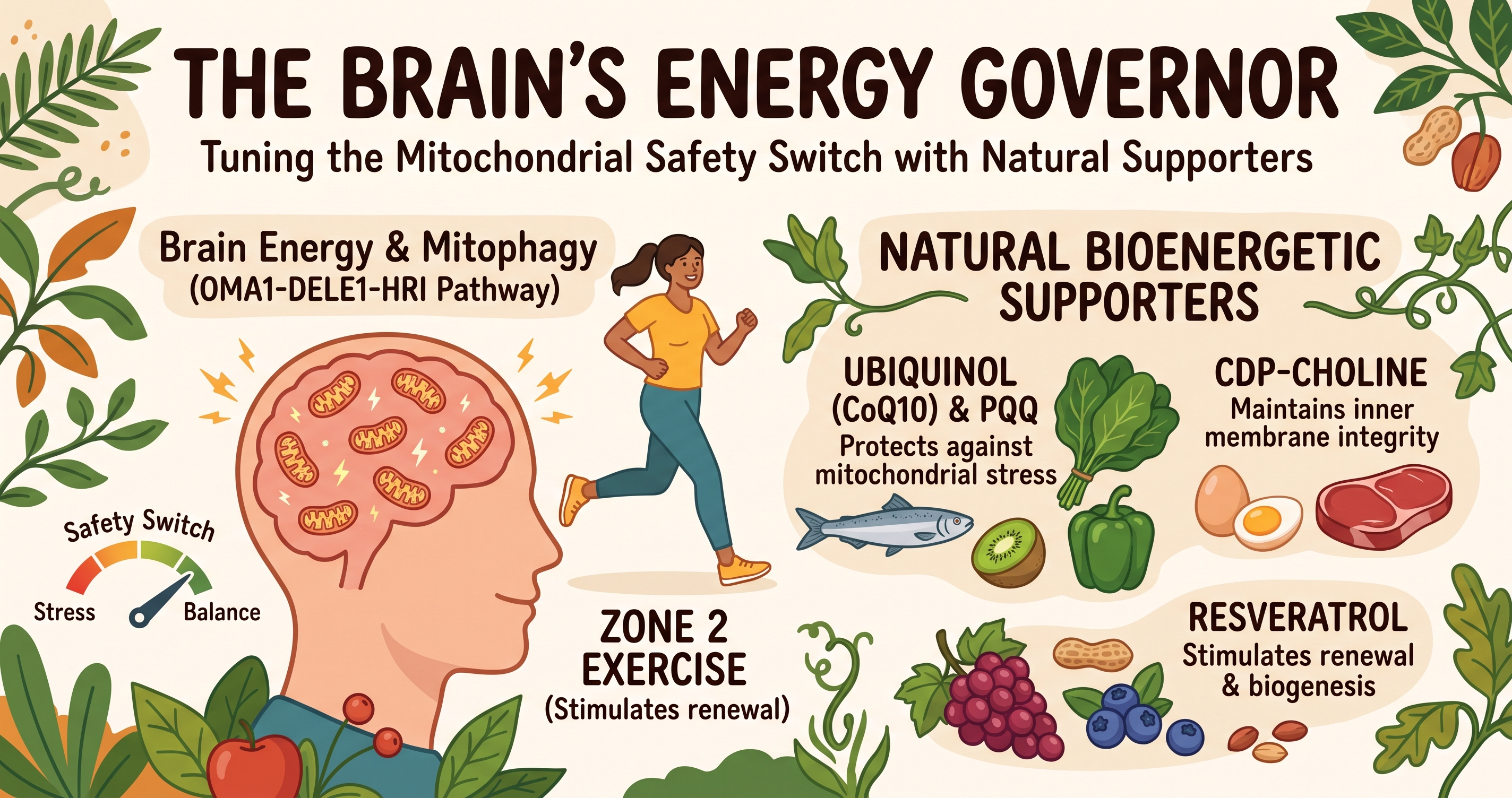
Neurons run on an unrelenting energy budget, relying on dense networks of mitochondria to fuel synaptic transmission and cognitive performance. When mitochondria experience stress or membrane depolarization, cells deploy quality-control measures to recycle dysfunctional organelles. However, uncontrolled clearance leads to metabolic collapse. A protective regulatory brake—the OMA1-DELE1-HRI pathway—functions as a biochemical governor, coordinating cellular survival with mitochondrial recycling to prevent premature energetic exhaustion.
The Molecular Feedback Loop
-
Mitochondrial Stress Detection: Depolarization or inner mitochondrial membrane stress activates the metalloprotease OMA1. Once activated, OMA1 cleaves DELE1 (DAP3-binding cell death enhancer 1).
-
Relaying the Distress Signal: Cleaved DELE1 relocates to the cytosol, where it directly binds and activates HRI (heme-regulated inhibitor, or EIF2AK1).
-
The Integrated Stress Response (ISR): Activated HRI phosphorylates the translation initiation factor eIF2α. This transiently dampens global protein translation to preserve scarce ATP while selectively upregulating stress-protective genes.
-
Balancing PINK1-Parkin Clearance: While the canonical PINK1-Parkin pathway labels severely degraded mitochondria via ubiquitination for autophagic clearance, the OMA1-DELE1-HRI axis prevents this process from turning into a run-away chain reaction. By moderating bioenergetic demand, the cell maintains enough functional "power plants" to prevent full bioenergetic shutdown.
Practical Bioenergetic Applications & Synergies
Mitochondrial longevity requires a precise "Goldilocks zone": stimulating turnover without outstripping the pool of functional mitochondria. Indiscriminate or overly aggressive autophagy can trigger energetic depletion.
-
Preserving Membrane Potential: Compounds that directly facilitate electron transfer along the respiratory chain, such as Ubiquinol (CoQ10) and Pyrroloquinoline Quinone (PQQ), alleviate excessive membrane stress and prevent hyper-activation of OMA1.
-
Protecting the Inner Membrane: Maintaining cardiolipin integrity with phospholipid precursors (such as CDP-Choline) and lipid-soluble antioxidants shields inner-membrane proteases from oxidative triggers.
-
Stimulating Counter-Biogenesis: Pairing clearance triggers with targeted biogenesis pathways ensures that recycled components are replaced. Structured, steady-state Zone 2 aerobic exercise and resveratrol stimulate PGC-1$\alpha$, matching mitophagy with renewed mitochondrial synthesis.
Reference Singh S, Sharma A, Rajan RK, Chakraborty M, Bhattacharjee A. Understanding the OMA1-DELE1-HRI Axis and PINK1-parkin-mediated Mitophagy in Parkinson's Disease. CNS Neurol Disord Drug Targets. Published online June 8, 2026. doi: 10.2174/0118715273469080260515103009. https://pubmed.ncbi.nlm.nih.gov/42261169/