August 13, 2026
Crossfire in the Brain: The Dangerous Science of Supplement-Drug Interactions
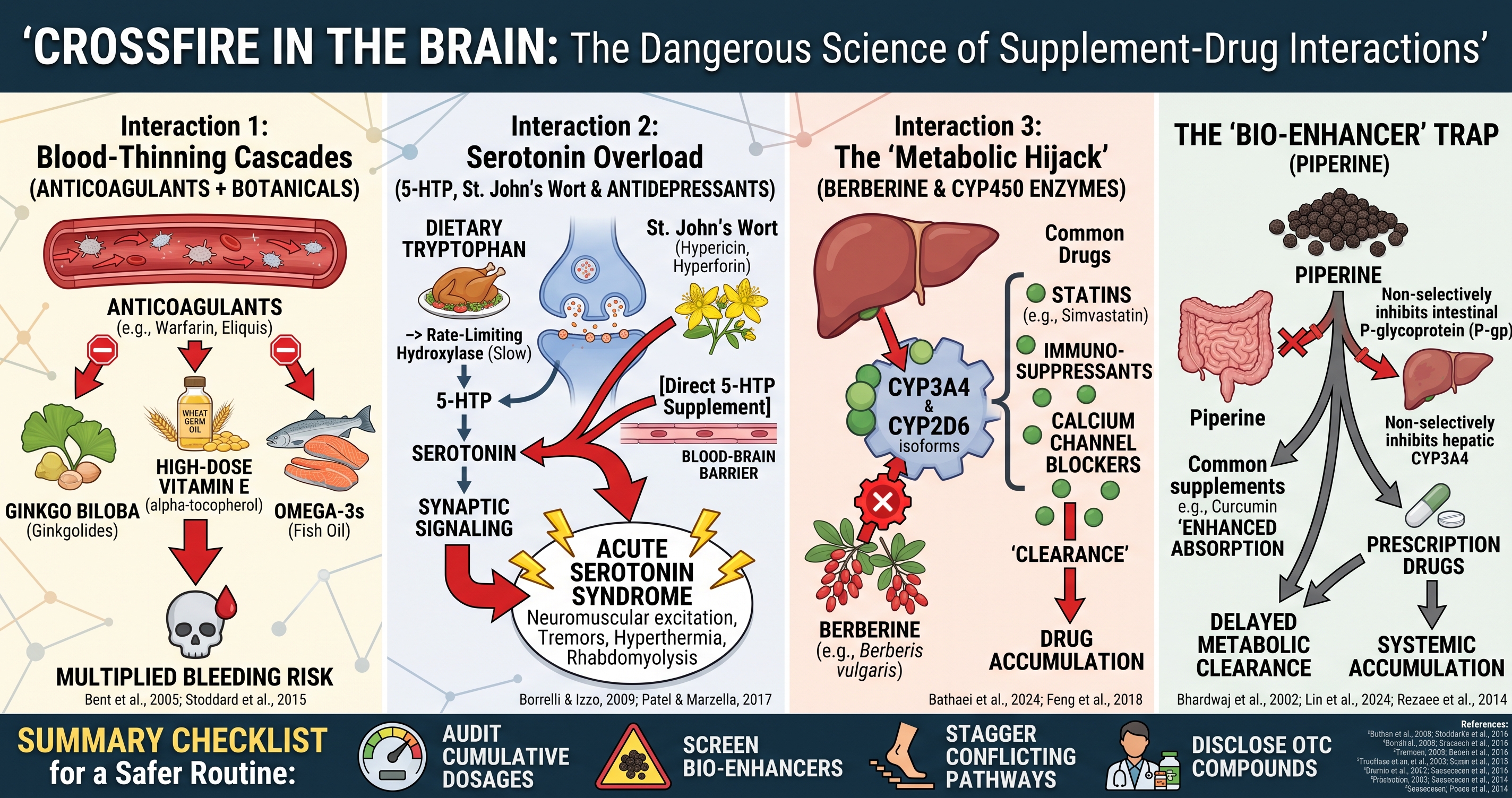
When Bioactive Compounds Collide
Dietary supplements and nootropics are biologically active agents. When stacked together or combined with common prescription medications, they can act as metabolic "switches"—either massively amplifying a drug's potency or neutralizing its therapeutic benefits.
Interaction 1: The Blood-Thinning Cascades (Anticoagulants + Botanicals)
Many popular cognitive enhancers improve brain performance by enhancing microvascular blood flow or inhibiting platelet aggregation.
-
Ginkgo Biloba, High-Dose Vitamin E, and Omega-3s: Ginkgo biloba contains ginkgolides that inhibit Platelet-Activating Factor (PAF). When a person taking prescription blood thinners (like Warfarin, Eliquis, or daily Aspirin) stacks Ginkgo Biloba or high-dose Vitamin E (alpha-tocopherol), their bleeding risk multiplies.
-
The Clinical Evidence: Systematic reviews and large clinical population analyses demonstrate that concurrent use of Ginkgo biloba with anticoagulants like warfarin significantly increases the hazard ratio for bleeding adverse events (Bent et al., 2005; Stoddard et al., 2015). When high-dose Vitamin E (alpha-tocopherol) or concentrated Omega-3 fatty acids are layered on top, the additive antiplatelet effect creates compounding bleeding risks.
Interaction 2: Serotonin Overload (5-HTP, St. John's Wort & Antidepressants)
One of the most dangerous supplement collisions occurs in neurotransmitter pathways.
Dietary Tryptophan ──(Rate-Limiting Hydroxylase)──> 5-HTP ──> Serotonin ──> Synaptic Signaling
                                                                    ▲
                                                     [Direct 5-HTP Supplement]
-
5-HTP (5-Hydroxytryptophan): Unlike dietary tryptophan, supplemental 5-HTP directly crosses the blood-brain barrier and decarboxylates into serotonin, bypassing the body's natural rate-limiting enzymatic checkpoint (tryptophan hydroxylase) (Patel & Marzella, 2017).
-
St. John's Wort (Hypericum perforatum): Contains hypericin and hyperforin, which inhibit the reuptake of monoamines including serotonin, dopamine, and norepinephrine (Borrelli & Izzo, 2009).
-
The Danger: When individuals taking Selective Serotonin Reuptake Inhibitors (SSRIs) or SNRIs add 5-HTP or St. John's Wort, extracellular serotonin concentrations can rapidly surge to toxic levels. Documented clinical cases show this combination can precipitate acute Serotonin Syndrome, presenting with neuromuscular excitation, tremors, hyperthermia, rhabdomyolysis, and life-threatening compartment syndrome (Borrelli & Izzo, 2009; Patel & Marzella, 2017).
Interaction 3: The "Metabolic Hijack" (Berberine & CYP450 Enzymes)
Substances you ingest must be cleared by Phase I liver enzymes (primarily the Cytochrome P450 family) and efflux transporters.
-
Berberine's Enzyme Blockade: Widely used for glycemic control and metabolic support, berberine is a potent inhibitor of human CYP3A4 and CYP2D6 isoforms (Bathaei et al., 2024; Feng et al., 2018). Because more than 50% of pharmaceutical medications—including statins, immunosuppressants, and calcium channel blockers—depend on CYP3A4 for clearance, berberine can cause prescribed drug levels to accumulate systemically (Bathaei et al., 2024; Feng et al., 2018).
-
The "Bio-Enhancer" Trap (Piperine): Black pepper extract (piperine) is widely added to supplement blends to boost the absorption of poorly bioavailable nutrients like curcumin. However, human microsomal and pharmacokinetic modeling studies prove that piperine non-selectively inhibits intestinal P-glycoprotein (P-gp) and hepatic CYP3A4, significantly delaying the metabolic clearance of co-administered prescription drugs (Bhardwaj et al., 2002; Lin et al., 2024; Rezaee et al., 2014).
Summary Checklist for a Safer Routine
- Audit Cumulative Dosages: Check total milligram loads across every product to prevent accidental overdosing.
- Screen Bio-Enhancers: Avoid unmonitored piperine formulations if taking narrow-therapeutic-index medications.
- Stagger Conflicting Pathways: Avoid stacking multiple CNS stimulants or combined GABAergic/sedative agents.
- Disclose OTC Compounds: Always share your complete supplement and nootropic stack with your physician or pharmacist.
References
Bathaei, P., Imenshahidi, M., & Hosseinzadeh, H. (2024). Effects of Berberis vulgaris, and its active constituent berberine on cytochrome P450: a review. Naunyn-Schmiedeberg's Archives of Pharmacology, 398, 179–202. https://doi.org/10.1007/s00210-024-03326-x
Bent, S., Goldberg, H., Padula, A., & Avins, A. L. (2005). Spontaneous bleeding associated with Ginkgo biloba: a case report and systematic review of the literature. Journal of General Internal Medicine, 20(7), 657–661. https://doi.org/10.1111/j.1525-1497.2005.0121.x
Bhardwaj, R. K., Glaeser, H., Becquemont, L., et al. (2002). Piperine, a major constituent of black pepper, inhibits human P-glycoprotein and CYP3A4. Journal of Pharmacology and Experimental Therapeutics, 302(2), 645–650. https://doi.org/10.1124/jpet.102.034728
Borrelli, F., & Izzo, A. A. (2009). Herb–Drug Interactions with St John's Wort (Hypericum perforatum): an Update on Clinical Observations. The AAPS Journal, 11(4), 710–727. https://doi.org/10.1208/s12248-009-9146-8
Feng, P., Zhao, L., Guo, F., et al. (2018). The enhancement of cardiotoxicity that results from inhibiton of CYP 3A4 activity and hERG channel by berberine in combination with statins. Chemico-Biological Interactions, 293, 115–123. https://doi.org/10.1016/j.cbi.2018.07.022
Lin, F., Hu, Y., Zhang, Y., et al. (2024). Predicting Food–Drug Interactions between Piperine and CYP3A4 Substrate Drugs Using PBPK Modeling. International Journal of Molecular Sciences, 25(20), 10955. https://doi.org/10.3390/ijms252010955
Patel, Y. A., & Marzella, N. (2017). Dietary Supplement-Drug Interaction-Induced Serotonin Syndrome Progressing to Acute Compartment Syndrome. American Journal of Case Reports, 18, 926–930. https://doi.org/10.12659/ajcr.904375
Rezaee, M. M., Kazemi, S., Kazemi, M. T., et al. (2014). The effect of piperine on midazolam plasma concentration in healthy volunteers, a research on the CYP3A-involving metabolism. DARU Journal of Pharmaceutical Sciences, 22(1), 8. https://doi.org/10.1186/2008-2231-22-8
Stoddard, G. J., Archer, M., Shane-McWhorter, L., et al. (2015). Ginkgo and Warfarin Interaction in a Large Veterans Administration Population. AMIA Annual Symposium Proceedings, 2015, 1174–1183.