September 9, 2026
Reinforcing the Brain's Gatekeepers: How Pentoxifylline Targets Blood-Brain Barrier Integrity to Buffer Stress
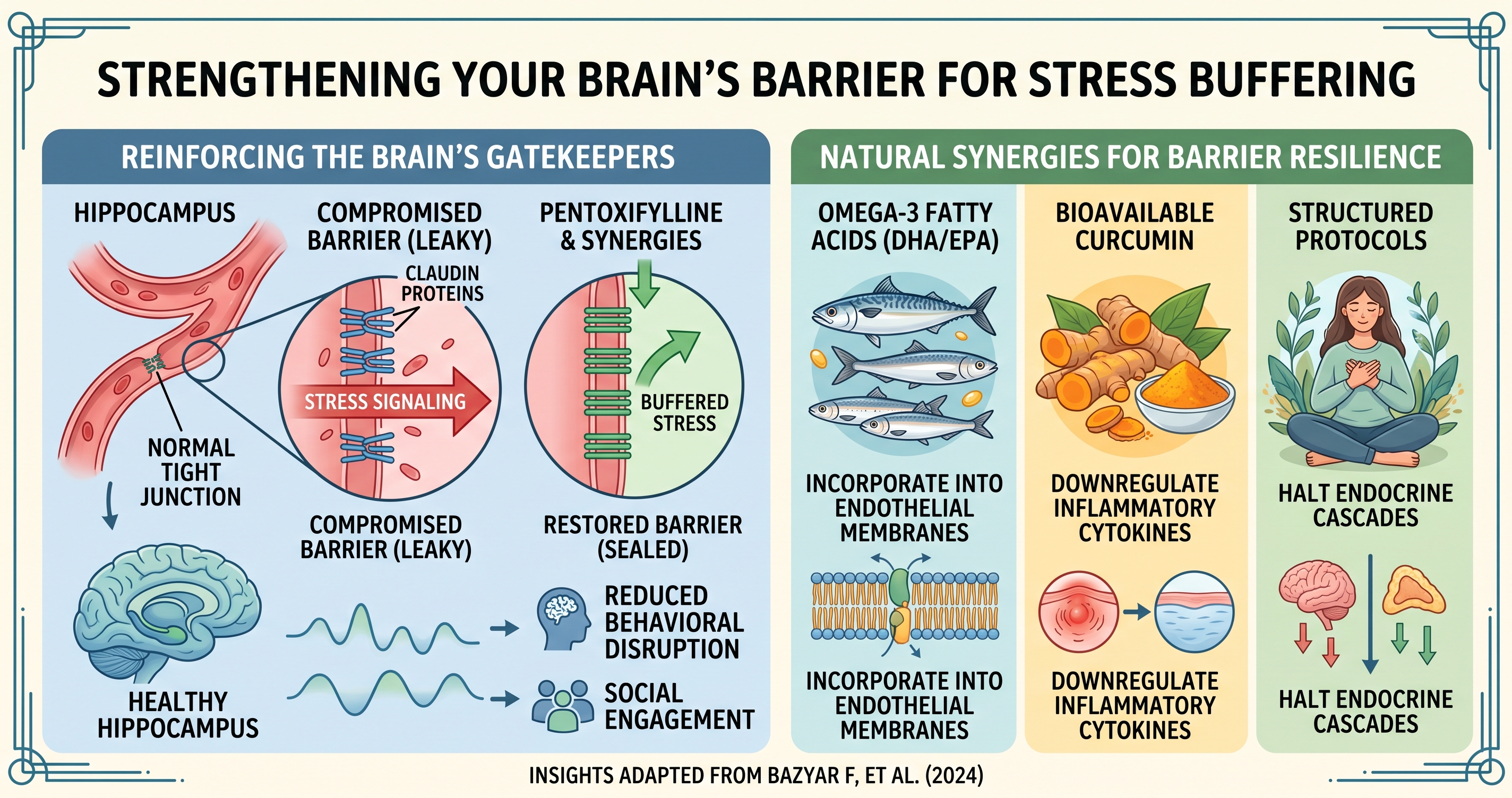
Early-life stress and intense environmental pressures can leave deep imprints on neurodevelopment, frequently manifesting as behavioral dysregulation, social withdrawal, and altered cognitive processing. Groundbreaking preclinical research has pinpointed a physical structural breakdown behind these stress-induced vulnerabilities: compromised tight junctions in the hippocampus. Investigating the xanthine-derived vascular agent pentoxifylline reveals that repairing the brain's microvascular defenses can directly mitigate behavioral disruption.
The Mechanism: Restoring Hippocampal Tight Junctions Rather than solely shifting neurotransmitter levels, pentoxifylline acts directly on the vascular architecture that shields brain tissue:
-
Modulating Claudin Expression: The blood-brain barrier (BBB) depends on transmembrane proteins called claudins to maintain tight junctions between endothelial cells. Pentoxifylline recalibrates claudin expression in the hippocampus, helping seal a barrier made leaky by severe stress.
-
Attenuating Autistic-Like Behaviors: In animal models exposed to early maternal separation stress, stabilizing hippocampal claudin levels directly reduced stress-induced autistic-like behavioral patterns.
-
Preserving Microvascular Integrity: By acting as a hemorheologic modifier and methylxanthine, pentoxifylline dampens neuroinflammatory signaling across brain microvessels, preserving the hippocampal microenvironment necessary for typical behavioral adaptation.
Human Constraints & Pharmacological Context Translating these vascular mechanisms to human application requires a clear understanding of delivery and safety:
-
Dosing Realities: The preclinical study established behavioral efficacy via daily systemic injections of 10 to 30 mg/kg over two weeks. Oral human equivalents require precise pharmacokinetic modeling to match systemic blood-brain barrier modulation without triggering gastrointestinal distress.
-
Methylxanthine Dynamics: While no overt toxicities emerged in the trial, pentoxifylline shares molecular lineage with compounds like caffeine and theobromine. It carries known interactions with blood pressure medications, anticoagulants, and adenosine signaling that necessitate professional medical oversight.
Synergistic Formulations for Barrier Resilience To target blood-brain barrier maintenance and stress buffering through accessible biochemical pathways, researchers highlight several synergistic pairings:
-
Omega-3 Fatty Acids (DHA/EPA): Essential structural lipids that incorporate into brain endothelial cell membranes, naturally reinforcing tight-junction stability and claudin alignment.
-
Bioavailable Curcumin: A potent downregulator of inflammatory cytokines that drive BBB hyperpermeability, synergizing with barrier-restoring compounds to safeguard neural tissue against systemic inflammation.
-
Structured Neurovascular Protocols: Pairing barrier-supportive nutrition with intentional stress-reduction routines (such as breathwork and circadian regulation) to halt the endocrine cascades that degrade tight-junction proteins during chronic psychological pressure.
Reference Bazyar F, et al., Pentoxifylline, possibly by modulating expression of claudins in the hippocampus, attenuates autistic-related behaviors in male mice subjected to maternal separation stress. Brain Research. 2024 Jul 15;1835:148924. doi: 10.1016/j.brainres.2024.148924. Epub 2024 Apr 18. PMID: 38642674 (https://pubmed.ncbi.nlm.nih.gov/38642674/)