August 14, 2026
The "Natural" Illusion: Why Supplement Stacking Can Overwhelm Your Liver and Kidneys
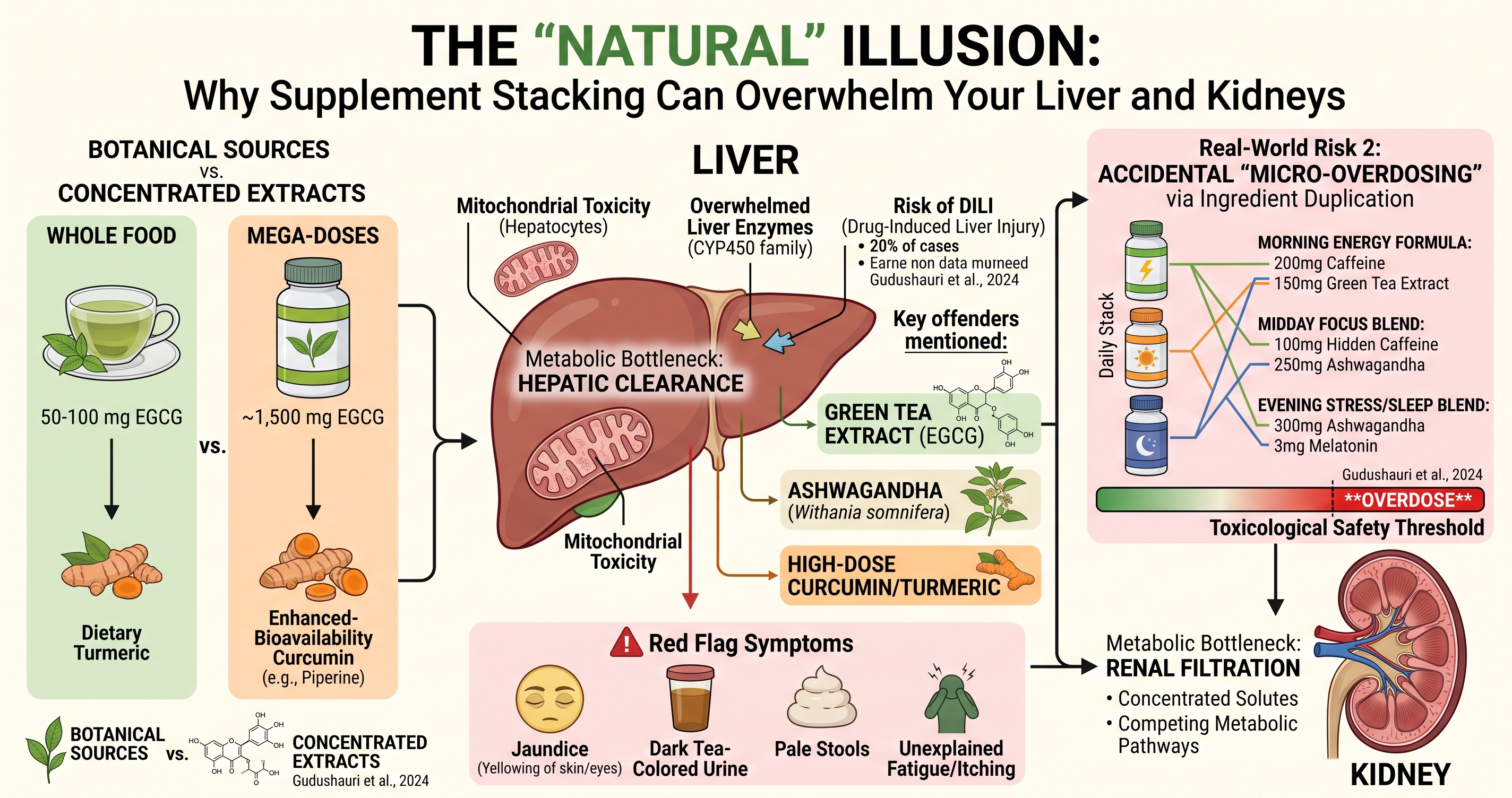
The Myth of "More Is Better"
In the era of nootropic stacks, longevity regimens, and biohacking, it is common to take 10 to 15 different dietary supplements a day. Because these compounds are sold over the counter with "all-natural" labels, many assume they carry zero toxicity.
However, your body does not process a concentrated botanical extract the same way it handles a whole food. High-dose, multi-supplement stacking creates two major metabolic bottlenecks: hepatic clearance and renal filtration.
Real-World Risk 1: Drug-Induced Liver Injury (DILI)
Herbal and dietary supplements (HDS) are now responsible for roughly 20% of all drug-induced liver injury cases in the United States. When concentrated botanicals enter the digestive tract in mega-doses, liver enzymes (such as the Cytochrome P450 family) and mitochondrial membranes can become overwhelmed.
-
Green Tea Extract (EGCG): While drinking a cup of green tea delivers 50–100 mg of epigallocatechin gallate (EGCG) alongside balancing compounds, concentrated fat-burner or nootropic extracts often deliver 800 mg to over 1,500 mg of pure EGCG in a single dose. Clinical hepatology data shows that concentrated EGCG can cause direct mitochondrial toxicity in hepatocytes, especially when taken on an empty stomach (Gudushauri et al., 2024; Patel-Rodrigues et al., 2024).
-
Ashwagandha (Withania somnifera): Increasingly recognized in clinical registries, high-dose Ashwagandha extracts have been implicated in acute cholestatic and hepatocellular liver injury with jaundice (Khan et al., 2022; Patel-Rodrigues et al., 2024).
-
High-Dose Curcumin/Turmeric: While dietary turmeric is safe, enhanced-bioavailability curcumin formulations (e.g., paired with black pepper/piperine or lipid nanoparticles) dramatically amplify systemic absorption. When combined with multiple other anti-inflammatory supplements, cumulative intake can exceed liver clearance thresholds (Gudushauri et al., 2024).
Red Flag Symptoms: Jaundice (yellowing of skin or eyes), dark tea-colored urine, pale stools, and unexplained fatigue or itching are clinical signals of liver distress.
Real-World Risk 2: Accidental "Micro-Overdosing"
A common pitfall identified in routine supplement audits is ingredient duplication:
- A morning energy formula contains 200 mg of caffeine and 150 mg of green tea extract.
- A midday "focus blend" contains another 100 mg of hidden caffeine and 250 mg of Ashwagandha.
- An evening stress/sleep blend adds another 300 mg of Ashwagandha and 3 mg of Melatonin.
Individually, each bottle looks safe. Stacked together, the user is consuming daily doses that exceed toxicological safety thresholds, stressing the kidneys with concentrated solutes and the liver with competing metabolic pathways.
References
Borrelli, F., & Izzo, A. A. (2009). Herb–Drug Interactions with St John's Wort (Hypericum perforatum): an Update on Clinical Observations. The AAPS Journal, 11(4), 710–727. https://doi.org/10.1208/s12248-009-9146-8
Gudushauri, N., Navarro, V. J., & Halegoua-De Marzio, D. (2024). A comprehensive update in herbal and dietary supplement–induced liver injury. Clinical Liver Disease, 23(1). https://doi.org/10.1097/cld.0000000000000185
Haacker, L., Maliekel, M., Bardsley, C. E. H., et al. (2018). Serotonin Syndrome Following Septal Myectomy in Association With Fentanyl and Methylene Blue: A Case Report. Psychosomatics, 59(5), 512–516. https://doi.org/10.1016/j.psym.2018.02.001
Khan, A., Chauhan, K., Ross, H., et al. (2022). A Comprehensive Review on the Use of Herbal Dietary Supplements in the USA, Reasons for Their Use, and Review of Potential Hepatotoxicity. Livers, 2(3), 119–138. https://doi.org/10.3390/livers2030011
Patel-Rodrigues, P. A., Cundra, L., Alhaqqan, D., et al. (2024). Herbal- and Dietary-Supplement-Induced Liver Injury: A Review of the Recent Literature. Livers, 4(1), 94–118. https://doi.org/10.3390/livers4010008