September 14, 2026
Gut Feelings, Brain Health: Decoding the Microbiota-Tryptophan Axis
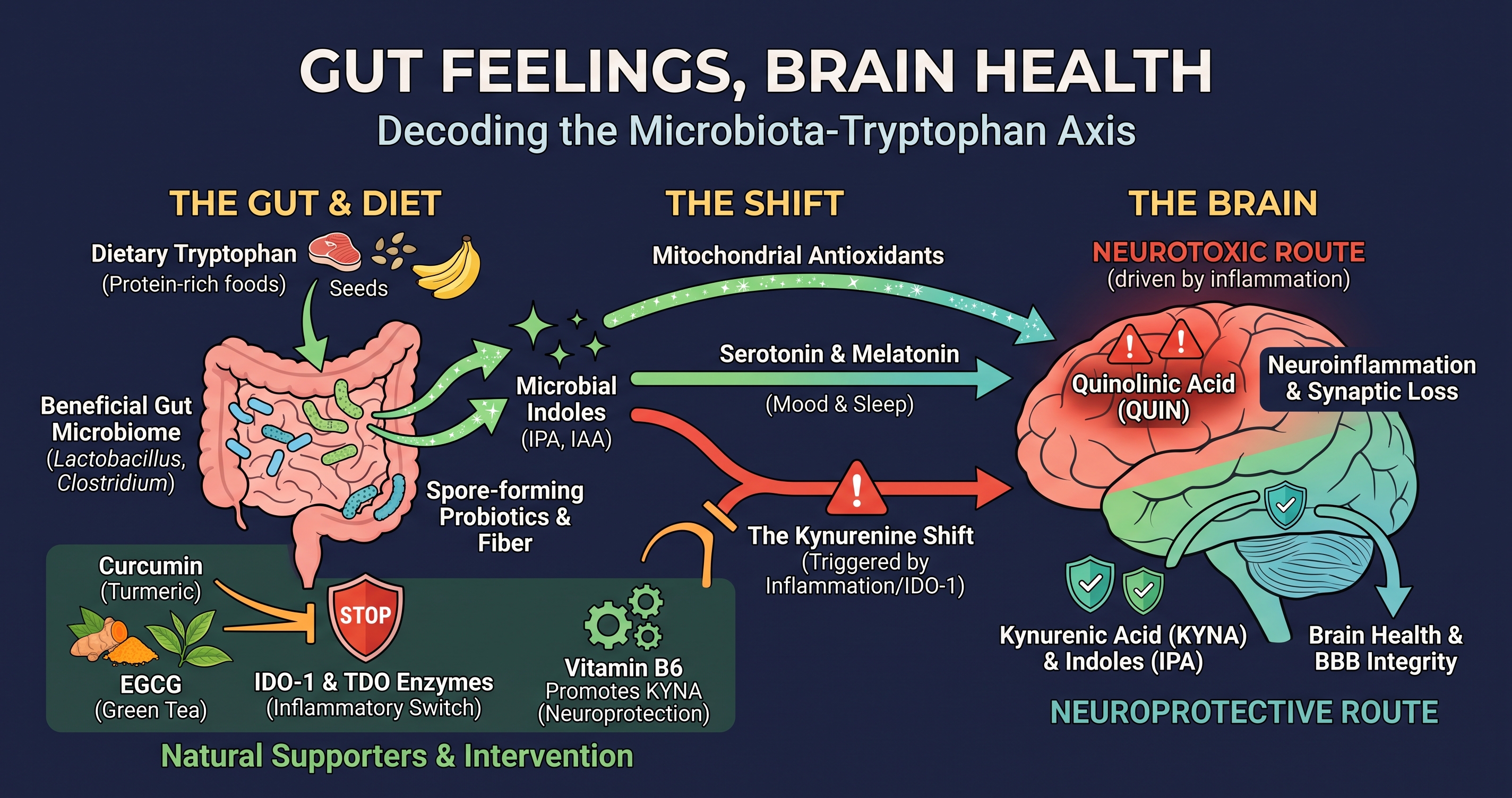
Tryptophan is best known as the precursor to serotonin and melatonin, but in the central nervous system, its journey is far more complex. Over 90% of dietary tryptophan does not turn into serotonin; instead, it is funneled through the kynurenine pathway or metabolized directly by gut microbes into neuroactive indoles. When the gut microbiome falls into dysbiosis, this metabolic balance shifts toward neurotoxic intermediates that drive chronic neuroinflammation and synaptic loss.
The Biochemical Pathways
-
The Kynurenine Shift: Under inflammatory signaling (driven by cytokines like IFN-$\gamma$ and TNF-$\alpha$), the enzymes indolamine 2,3-dioxygenase (IDO-1) and tryptophan 2,3-dioxygenase (TDO) are upregulated. This shunts tryptophan away from serotonin synthesis and toward kynurenine.
-
Neurotoxic vs. Neuroprotective Branches: Kynurenine branches into two opposing routes. Microglial activation drives production of quinolinic acid (QUIN), a potent NMDA-receptor agonist that triggers excitotoxicity, reactive oxygen species (ROS), and lipid peroxidation. Conversely, astrocytic flux produces kynurenic acid (KYNA), an NMDA antagonist that confers neuroprotection when balanced. In neurodegenerative states (such as Alzheimer's and Parkinson's), the QUIN/KYNA ratio skews heavily toward excitotoxic damage.
-
Microbial Indole Metabolites: Commensal bacteria (including Lactobacillus and Clostridium species) convert unabsorbed tryptophan into indole, indole-3-propionic acid (IPA), and indole-3-acetic acid (IAA). IPA acts as a potent mitochondrial antioxidant and activates the aryl hydrocarbon receptor (AhR), preserving blood-brain barrier integrity and suppressing microglial overactivation.
Practical Implications & Nootropic Synergies
Relying on unguided high-dose L-tryptophan or 5-HTP supplementation carries significant caveats: if systemic or gut-derived neuroinflammation is active, supplemental tryptophan can simply feed into the neurotoxic quinolinic acid cascade rather than boosting mood or cognition.
-
Targeting the Microenvironment First: Normalize gut permeability and reduce gut dysbiosis using spore-forming probiotics or butyrate-producing dietary fibers before aggressively loading precursor amino acids.
-
Synergistic Quenching with Polyphenols: Flavonoids such as EGCG (epigallocatechin gallate) and curcumin inhibit IDO-1 activity, attenuating the pathological diversion of tryptophan into the excitotoxic kynurenine arm.
-
Cofactor Repletion: The enzyme kynurenine aminotransferase (which converts kynurenine to protective KYNA) is vitamin $B_6$-dependent (pyridoxal 5'-phosphate). Maintaining adequate $B_6$ levels helps steer kynurenine metabolism away from quinolinic acid accumulation.
Reference Roth W, Zadeh K, Vekariya R, Ge Y, Mohamadzadeh M. Diversity of the Tryptophan-Microbiome-Brain Axis in Neurodegenerative Diseases. Ageing Research Reviews. 2021 Sep 1. doi: 10.1016/j.arr.2021.101387. PMID: 34182148 https://pubmed.ncbi.nlm.nih.gov/34182148/