September 5, 2026
Beyond "Waste Product": How Lactate Shields the Aging Brain from Chronic Neuroinflammation
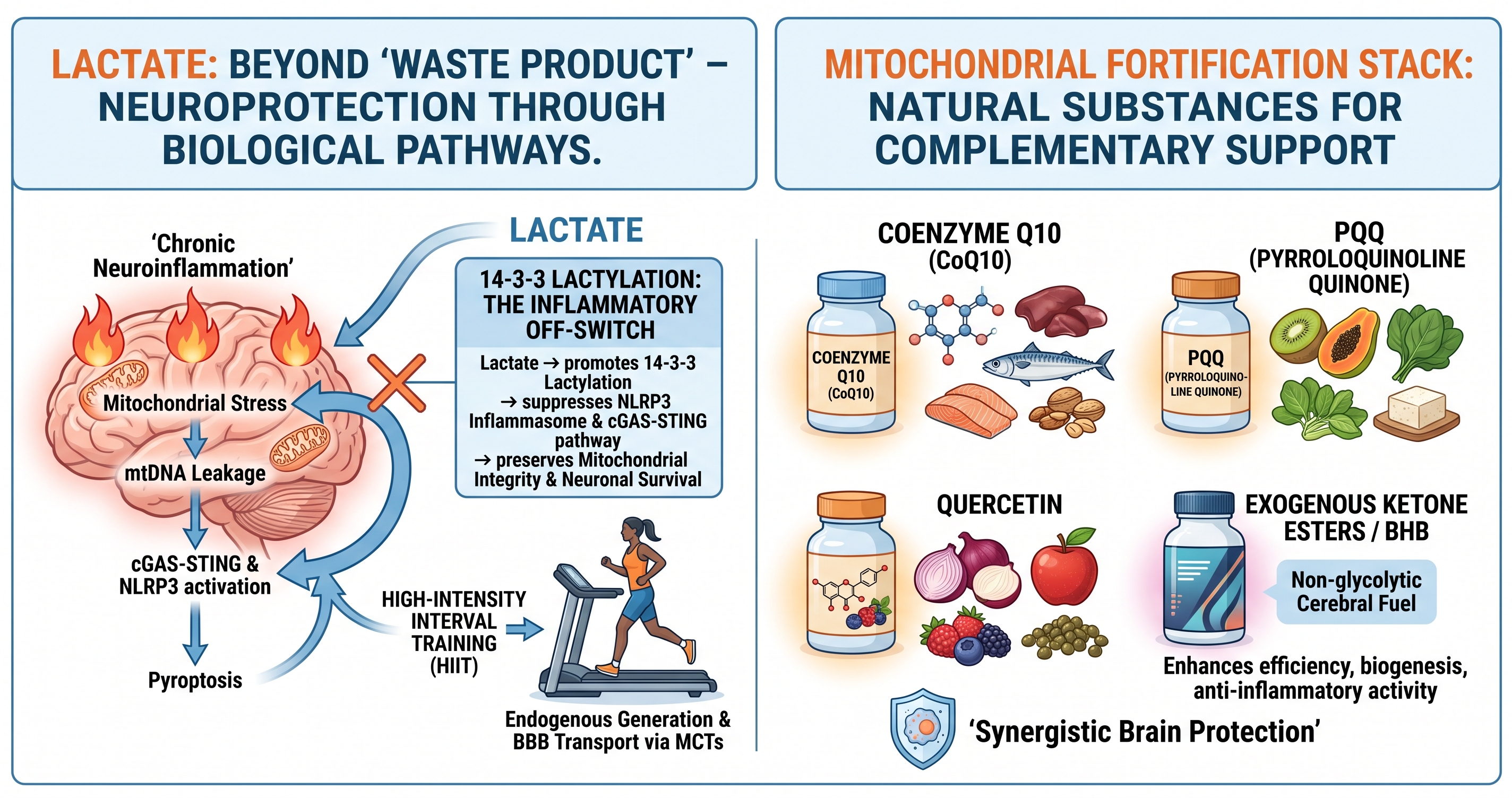
For decades, lactate was dismissed as nothing more than metabolic exhaust—a painful byproduct of anaerobic exertion that makes your muscles burn during an all-out sprint. Modern neurobiology tells a completely different story.
Emerging evidence reveals that lactate functions as a signaling molecule and a critical neural fuel. It can cross into brain cells and trigger post-translational protein modifications that directly quiet neuroinflammation and preserve dopaminergic pathways.
The Science: 14-3-3 Lactylation and the Inflammatory Off-Switch
In neurodegenerative conditions like Parkinson’s disease, a destructive cascade takes hold:
-
Mitochondrial Stress & DNA Leakage: Compromised neuronal mitochondria begin leaking mitochondrial DNA (mtDNA) into the cytosol.
-
Innate Immune Alarm: Cytosolic DNA triggers the cGAS-STING pathway, while cellular stress activates the NLRP3 inflammasome.
-
Pyroptosis & Neuronal Loss: Cleavage of gasdermin D (GSDMD) punches pores in cell membranes, inducing inflammatory cell death and driving progressive neuronal decline.
Lactate intervenes through an epigenetic and post-translational mechanism known as protein lactylation. By promoting the lactylation of 14-3-3 scaffold proteins, lactate orchestrates a multi-target shutdown of this cascade:
-
NLRP3 Inflammasome Suppression: It blocks the assembly of the NLRP3 platform, drastically cutting down pro-inflammatory cytokine release.
-
cGAS-STING Inhibition: It dampens downstream interferon-stimulated genes, preventing chronic immune activation from intracellular debris.
-
Mitochondrial Membrane Preservation: Limiting GSDMD-mediated disruption keeps mitochondrial compartments sealed, preventing further mtDNA spillage.
Practical Realities: The Bioavailability Hurdle
The laboratory finding relies on high localized central nervous system concentrations—delivered via intracerebroventricular administration in preclinical models. Replicating this neuroprotective threshold in humans comes with key physiological hurdles:
-
The Blood-Brain Barrier (BBB): Brain entry of lactate depends on monocarboxylate transporters (MCTs, primarily MCT1, MCT2, and MCT4). Circulating levels must rise sufficiently to create an influx gradient into astrocytes and neurons without causing systemic acidosis.
-
Metabolic Generation vs. Ingestion: Simply consuming exogenous lactate salts provides minimal Central Nervous System penetration and carries significant GI distress.
-
The Physiological Trigger: The most viable human delivery vehicle remains endogenous: High-Intensity Interval Training (HIIT) or threshold exercise. Sustained blood lactate spikes ($>4\text{ to }6\text{ mmol/L}$) facilitate robust BBB transport via upregulated MCT expression, driving lactate into neural pathways.
Rational Synergies: The Mitochondrial Fortification Stack
Because lactate operates primarily as a signaling brake on inflammatory destruction, pairing it with compounds that support structural bioenergetics creates a targeted approach:
-
Coenzyme Q10 (CoQ10) & PQQ: Support electron transport chain efficiency and stimulate mitochondrial biogenesis, reinforcing organelle integrity before mtDNA leakage occurs.
-
Quercetin: Exerts upstream antioxidant and anti-inflammatory activity, acting alongside lactate’s suppression of the NLRP3/cGAS-STING axis.
-
Exogenous Ketone Esters / BHB: Provide parallel non-glycolytic cerebral fuel that shares MCT transport pathways, offering complementary metabolic support for vulnerable neural tissue.
Academic Reference
Zheng K, Chen C, et al., Neuroprotection by Lactate in Parkinson's Disease: A Novel Anti-Inflammatory Mechanism via 14-3-3 Protein Lactylation. Journal of Neuroinflammation. 2026 May 15. doi: 10.1186/s12974-026-03120-w. Epub ahead of print. PMID: 42252031 (https://pubmed.ncbi.nlm.nih.gov/42252031/)