August 29, 2026
Beyond the Blood-Brain Barrier: How Astragaloside IV & the Gut-Brain Axis May Protect Cognitive Function
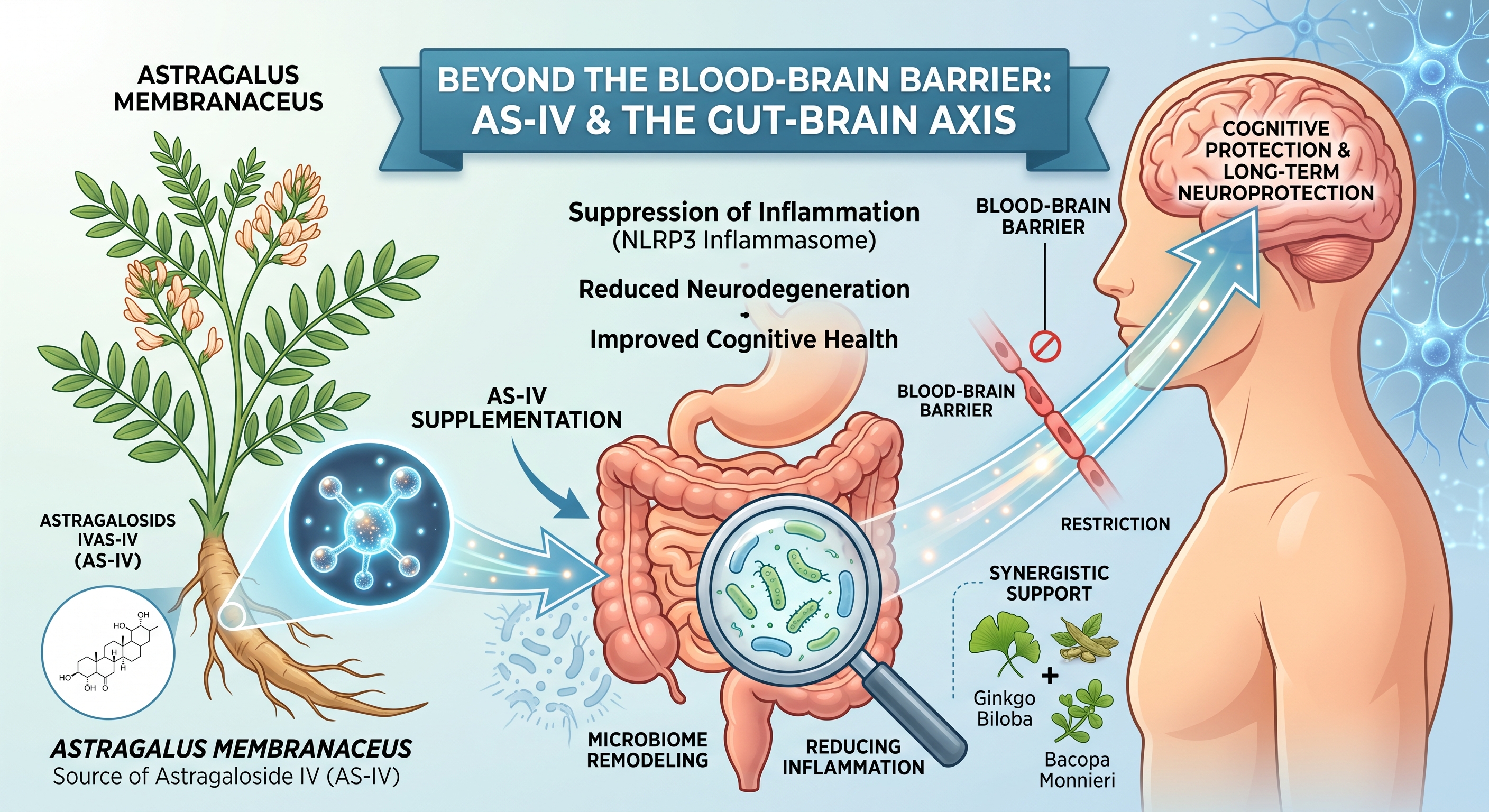
When searching for nootropics or brain-boosting supplements, most people focus on compounds that directly stimulate neurotransmitters or cross into the brain to boost blood flow. However, emerging neuroscience suggests one of the most effective ways to preserve cognitive function and protect neurons is by targeting the microbiome–gut–brain axis.
A prime example gaining scientific attention is Astragaloside IV (AS-IV), a bioactive saponin extracted from the traditional root Astragalus membranaceus.
The Gut-Brain Connection in Cognitive Longevity
The gut and the central nervous system communicate continuously via biochemical signaling, the vagus nerve, and systemic immune pathways. In neurodegenerative conditions such as Parkinson’s disease, pathological hallmarks—like the accumulation of misfolded $\alpha$-synuclein protein—are often accompanied by systemic inflammation and gut dysbiosis.
Research in animal models highlights how Astragaloside IV works via this indirect pathway:
-
Microbiome Remodeling: Rather than needing high concentrations to cross the blood-brain barrier directly, AS-IV acts locally in the digestive tract to reshape the microbial environment—balancing populations such as Bacteroidetes, Porphyromonadaceae, and Firmicutes.
-
Downregulating Neuroinflammation: By remodeling the gut flora, AS-IV helps suppress inflammatory signaling cascades, specifically the NLRP3 inflammasome, caspase-1, and pro-inflammatory cytokines like IL-1$\beta$.
-
Neuronal Protection: In preclinical models, this gut-level modulation translated to reduced dopaminergic neuron loss, decreased $\alpha$-synuclein overexpression, and improved motor performance.
The Bioavailability Puzzle: Why the Gut Route Matters
One historical hurdle for Astragaloside IV in nootropic research has been its relatively low permeability across the blood-brain barrier (BBB).
Traditional supplement design assumes that a brain compound must flood the cerebral cortex to work. However, the discovery that AS-IV exerts neuroprotective effects through gut microbiota remodeling provides a compelling alternative mechanism: a compound can deliver brain-protective benefits without needing massive BBB penetration, simply by calming peripheral inflammation and restoring gut-barrier balance at the source.
Synergistic Approaches to Cognitive Enhancement
In broader nootropic regimens, compounds that work through distinct pathways are often stacked together for a multi-targeted approach to brain health:
-
Astragaloside IV (Astragalus membranaceus): Supports systemic anti-inflammatory pathways, cellular longevity, and microbiome stability.
-
Bacopa Monnieri: Well-studied for supporting synaptic plasticity, memory consolidation, and acetylcholine signaling.
-
Ginkgo Biloba: Known for improving cerebral microcirculation and protecting against oxidative stress.
By combining gut-mediated anti-inflammatory agents with direct-acting nootropic botanicals, cognitive preservation protocols can address both cellular defense and acute mental performance.
Current Status & Safety
Astragalus membranaceus extracts have a long history of traditional use and are generally regarded as safe for general supplementation. However, preclinical studies on isolated Astragaloside IV use specific experimental models, and standard human clinical dosages for cognitive protection remain under active investigation.
As research into the microbiome-brain axis continues to expand, compounds that modulate gut ecology represent a promising new frontier in long-term neuroprotection and cognitive wellness.
reference: Cai J, Wang M, You Y, Sun F, Wang M, Wang N, Wang R, Zhang K, Ge R, Wang H. AS-IV attenuates nigral NLRP3 inflammasome in a Parkinson's disease mouse model via gut microbiota. Commun Biol. 2026 Jun 6. doi: 10.1038/s42003-026-10415-5. Epub ahead of print. PMID: 42251131.